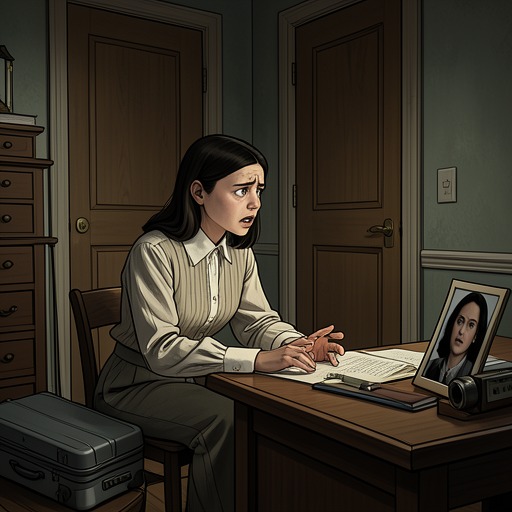
Carson and father's police department dispute
Holding Out for a Hero ▸ Stiles Stilinski (2)Carson’s Confrontation with Her Father is the decisive family rupture at the center of a police-station dispute. Carson’s estranged father arrives after hearing that his daughter has been given a restraining order connected to the kidnapping of Jackson Whittemore, but his attempt to discipline her instead exposes the older wound beneath the immediate crisis: Carson’s mother disappeared, her father withdrew, and the family never repaired itself. The confrontation makes Carson’s independence an emotional and narrative necessity rather than a simple act of teenage defiance.
Causes and Background
Carson’s history with her parents explains why the encounter carries a force disproportionate to the immediate accusation. Two years after Mrs. Stilinski died, Carson’s mother vanished from her life by choice. The disappearance was abrupt and unexplained: Carson left the house while her mother was baking cookies, and returned to find only a plate of chocolate cookies remaining. There was no note and no abandoned luggage, and Carson initially tried to interpret the absence as an ordinary interruption rather than a permanent departure. The missing explanation left the household organized around uncertainty and loss.
Her father’s response deepened that injury. Carson describes him as having been absent from her life for roughly four years, leaving her to experience her mother’s departure without the caregiving presence she expected from him. The police-station scene therefore brings two absences into the same room: the mother whose disappearance remains a wound and the father whose physical or emotional withdrawal has made that wound harder to survive. His sudden appearance is startling enough that Melissa McCall briefly reacts as though she has seen a ghost, emphasizing how unusual his presence has become.
The immediate trigger is official rather than domestic. Carson and her friends have been drawn into Jackson Whittemore’s dangerous situation, and her father has received a call from the police department saying that his daughter is facing a restraining order because she kidnapped the son of one of the town’s influential families. The charge gives him a reason to claim authority, but it also reveals the limits of the official account: the adults frame Carson’s actions as misconduct while Carson and her friends understand them as part of an emergency involving Jackson’s violent Kanima condition.
What Happens at the Station
Carson is with Stiles Stilinski and Scott McCall in the station hallway when her father approaches, red-faced and furious. He demands to know what she is doing there, and Carson answers with immediate hostility rather than the apologetic posture he expects. The encounter quickly becomes physical when he grabs her upper arm and tightens his hold after she tries to pull away. Stiles intervenes, pulling Carson from him and placing an arm around her shoulders. His intervention converts the dispute from a private parent-child reprimand into a visible conflict over Carson’s bodily autonomy and chosen relationship.
Carson’s father then forbids her from seeing Stiles again. Carson rejects the order because Stiles is not merely a boy associated with her recent trouble; he is the person she loves, and the relationship represents a commitment she has chosen for herself. Her response distinguishes parental status from parental care. She argues that a father is not simply a man who contributes genes and pays for a house, but a male parent who also acts as a caregiver. In her account, her father fulfilled the biological and financial functions while abandoning the emotional responsibility that would have given his authority legitimacy.
The confrontation reaches its sharpest point when Carson connects his behavior to her mother’s departure. She accuses him of pushing everything away because he cannot accept that her mother did not want to remain with him, while also insisting that the abandonment wounded Carson herself. Her anger is not presented as a single outburst detached from history; it is the delayed articulation of four years in which she believes he placed his own pain ahead of her need for protection and repair. She refuses to let him turn an apology into an escape from accountability, arguing that he had four years to mend the relationship and chose not to do so.
Emotional Consequences and Aftermath
Carson leaves before her father can complete an apology. She runs out of the police department, pushing through the front entrance as officers at the front desk look on, and the winter air precipitates the collapse she has been trying to prevent. Tears begin falling outside, although she resists them as evidence that the confrontation has taken power from her. The scene’s physical movement—from the enclosed hallway, to the grip on her arm, to Stiles’s protective embrace, and finally to Carson’s flight into the cold—tracks the breaking of the institutional and familial control being imposed on her.
Her grief is complicated by self-reproach. Carson tells herself that she is supposed to remain strong and that she should not allow either parent to control her through pain. Yet the mother’s memory returns through the father, and the unresolved loss destroys the fragile happiness she had been trying to preserve. The tears do not cancel her defiance; they show the cost of sustaining it. Carson has successfully spoken the accusation she has carried, but speaking it does not immediately heal the abandonment.
The station also functions as a place where several forms of authority collide. Gerard Argent, newly installed as principal, uses his first day to threaten detention and make students take responsibility for disorder. Carson and her friends later steal a police vehicle to contain Jackson, track information through the school, and endure a hostage crisis in which a gun is pressed into Carson’s back and Matt Daehler controls their movements. Against this wider pattern of adults and institutions declaring emergency powers, Carson’s father attempts to use parental authority as another form of confinement. Her refusal exposes the personal equivalent of the book’s larger question: who has the right to decide what happens to vulnerable young people when ordinary protection has failed?
Relationships and Conflict
Stiles’s role in the confrontation confirms the practical meaning of Carson and Stiles’s relationship. He does not remain a silent witness when Carson’s father grabs her; he physically separates them and stands beside her. Carson’s insistence that no one can place distance between them therefore follows an observable pattern of mutual defense rather than romantic abstraction. Their relationship offers the care she says her father withheld, even though it exists within the dangerous and improvised world of supernatural investigations.
Carson’s friendships likewise complicate the accusation that she is simply reckless. Scott McCall and Stiles are present during the confrontation, just as they are present when Carson helps contain Jackson in a stolen police vehicle and navigates the school’s surveillance and detention systems. Her actions repeatedly place her in danger, but they also arise from loyalty to people who cannot safely manage their own circumstances. The restraining order gives those actions a criminal appearance while the surrounding events establish the stakes that Carson’s father does not acknowledge.
Carson’s later conversation with Jackson Whittemore provides a revealing contrast to the conflict with her father. She admits that Jackson once broke up with her for her best friend, yet says she moved on after recognizing that they were bad together. She can therefore distinguish between a relationship that failed and a person who remains capable of change. Carson tells Jackson that beneath his cruelty he is a good person and argues that his connection with Lydia Martin matters because Lydia is the person he has truly cared about. Her willingness to recognize Jackson’s buried decency makes her condemnation of her father more precise: she is not incapable of forgiveness, but she refuses to confuse biological connection with moral responsibility.
Significance
The confrontation gives Carson a language of self-definition. Her father arrives intending to define her through a police report, a restraining order, and the authority of parenthood; Carson answers by defining the conditions under which authority deserves obedience. She will not accept control from someone who was absent when she needed care, and she will not allow the language of family to erase the evidence of abandonment.
The scene also turns disappearance into a recurring structure in Carson’s life. Her mother vanished without explanation, Lydia Martin disappeared in a supernatural crisis, and Carson herself repeatedly moves through systems that attempt to locate, monitor, detain, or restrain her. The police-station argument is the moment when that history becomes explicit. Carson cannot restore her family or obtain a satisfying explanation for her mother’s departure, but she can refuse to repeat the pattern by allowing another abandonment to dictate the terms of her future. Her exit is therefore both a breakdown and an act of separation: she leaves the station wounded, yet no longer willing to recognize her father’s claim over the life he failed to help raise.